

Every World Cup Player Faces Mandatory Cardiac Screening. That Data May Outlive Its Encryption.
Qtonic Quantum | Enterprise Quantum Risk Intelligence

Post-Quantum Readiness / The Remediability Problem
The 2026 FIFA World Cup opens June 11. Behind it, cardiac and identity records from squads across 48 nations move across borders on cryptography with a published deprecation horizon. A passport can be reissued. A pulse cannot. That single difference is the whole argument.
Qtonic Quantum Research Team | June 11, 2026
A stolen password is an inconvenience. A harvested heartbeat is forever.
When most data is compromised, the damage is real and then it ends. You rotate the password, reissue the card, revoke the certificate, re-document the passport. The clock starts again. Cardiac records, genetic markers, and the biometric elements in an identity file do not work that way. There is no future action that un-leaks them. They are sensitive for a lifetime, and a lifetime is longer than the encryption protecting them is guaranteed to hold.
That is the distinction at the center of the report we published today. Most breaches end. This kind does not.
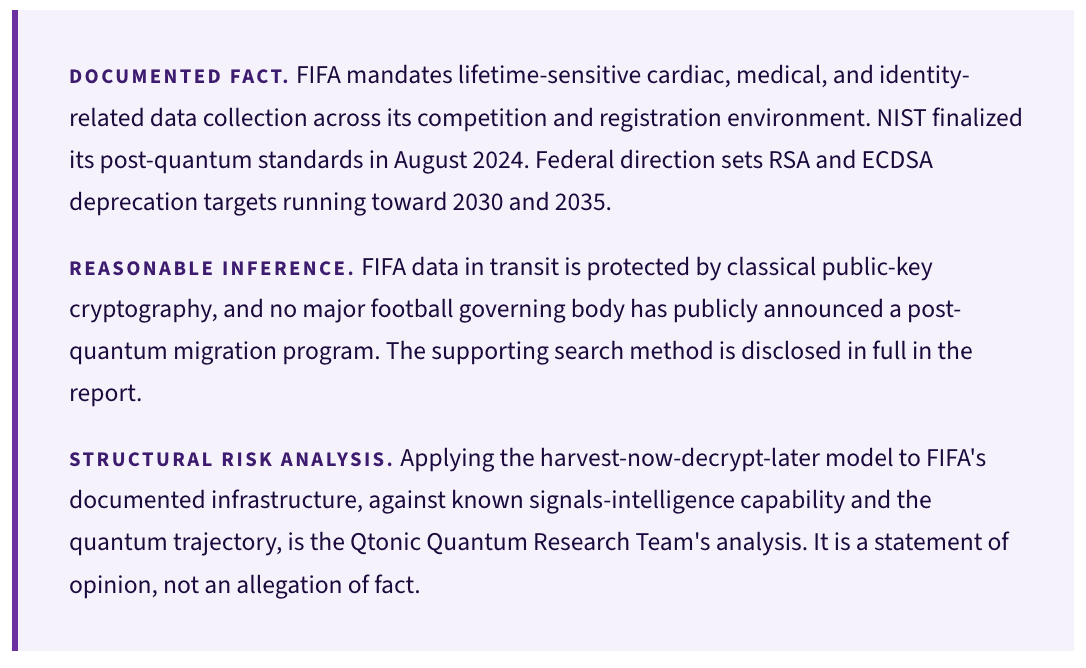
The 2026 FIFA World Cup opens June 11 at Estadio Azteca, the first of 104 matches across 16 cities in three countries over 39 days.1 It is the largest edition in the tournament’s history. It is also, on the evidence we reviewed, one of the most concentrated cross-border transfers of sensitive medical and identity data on the global sporting calendar, and it begins with no publicly announced post-quantum migration plan identified anywhere in football’s governance structure.
Our report is a structural risk analysis, not an allegation of a breach. It does not claim FIFA has been compromised, and it does not claim to know whether FIFA has an internal post-quantum plan. It states what the public record shows, labels every claim by its evidence category, and discloses the search method so the central claim can be checked. This piece is the short version of why the risk is material, why it is time-sensitive, and why it cannot be fixed after the fact.
The Remediability Ladder
Start with the variable that drives everything. In ordinary cybersecurity, the severity of a breach is bounded by how fast you can recover from it. That recovery time is short for almost everything an organization holds. It is the entire reason most breaches, however painful, are survivable.
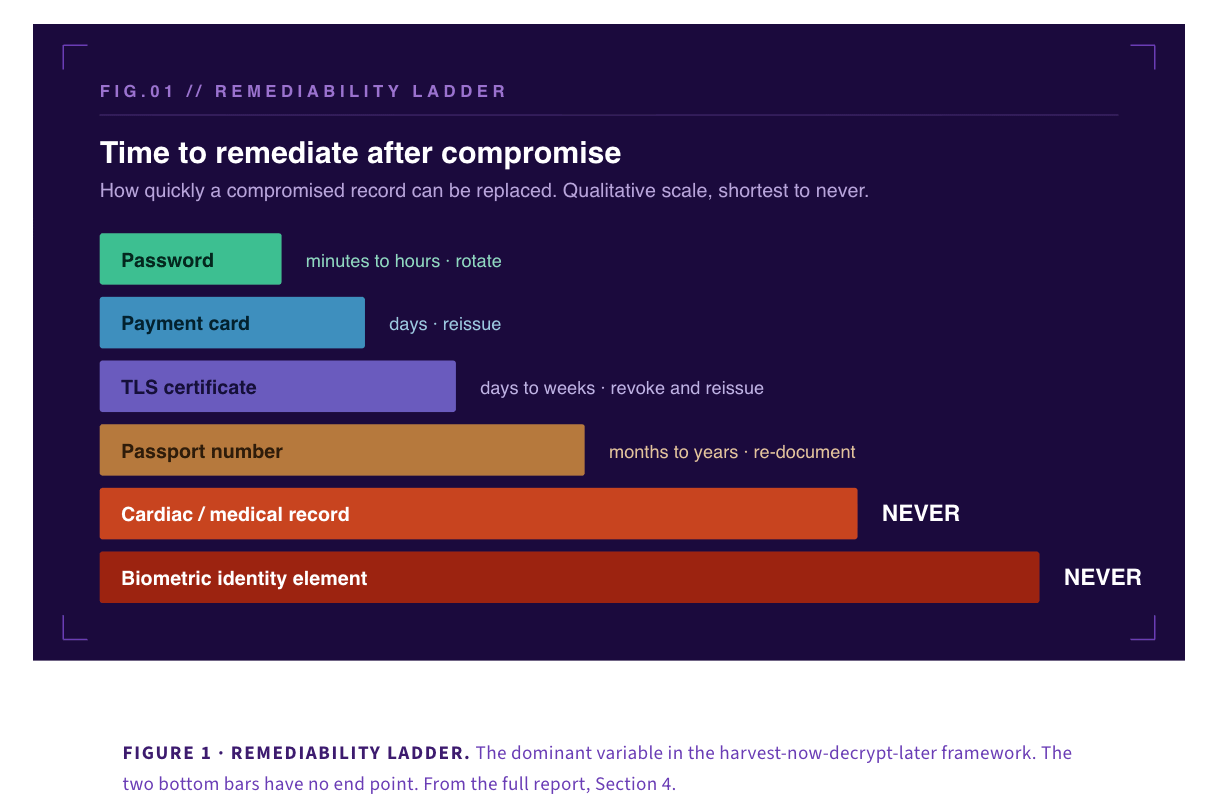
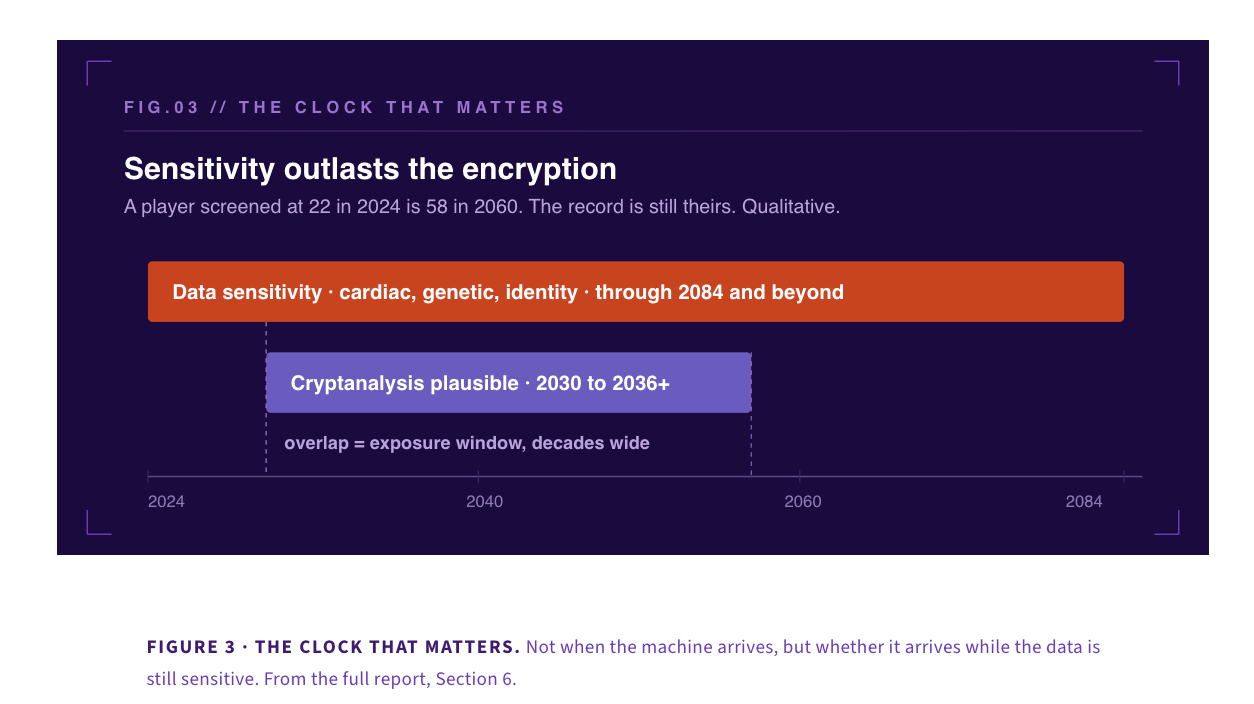
A cardiac ECG recorded on a 22-year-old player in 2024 is still valid, still sensitive, and still that person’s medical record in 2060, when they are 58. If a copy was captured in transit and stored, the moment a sufficiently capable quantum computer exists, that record becomes readable. The collection already happened. Only the decryption is still waiting.
Why Football, Specifically
The harvest-now-decrypt-later threat applies to every organization using quantum-vulnerable cryptography. The question the report asks is narrower. Does FIFA’s specific data environment warrant differentiated attention? The answer is yes, not because any single factor is unique, but because of how four of them stack.
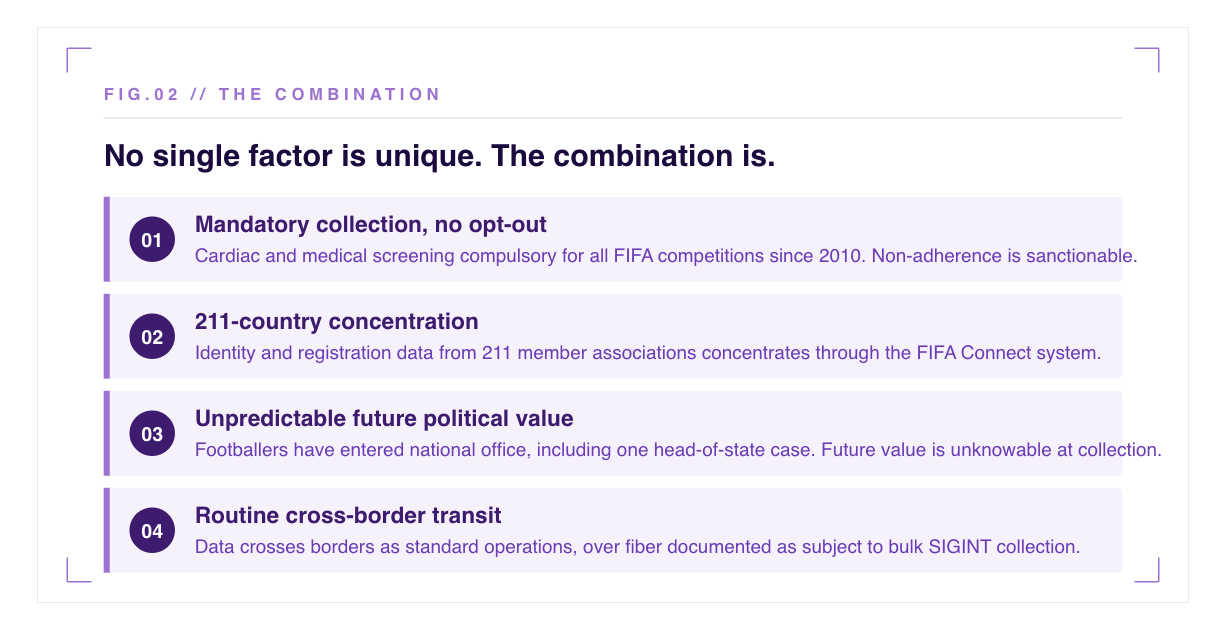
Figure 2 · The combination. The report could not identify a comparable public case in sport combining all four characteristics at once. From the full report, Section 4.
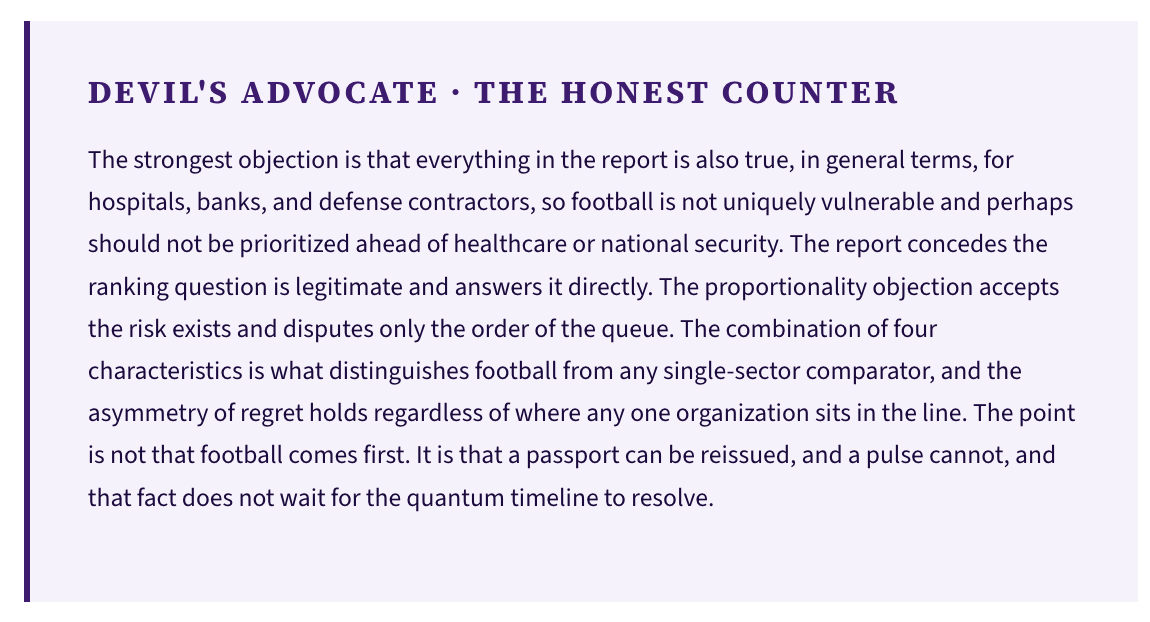
A hospital collects medical data. A passport agency concentrates identity records. A defense contractor routinely moves data across borders. What the report could not find a comparable public case for is the combination, all four at once, in a single federated environment with no sovereign-grade security and no right of refusal.
The Clock That Actually Matters
The common objection to any harvest-now-decrypt-later argument is that the quantum timeline is uncertain, and a machine capable of breaking today’s encryption may be a decade or more away. That is true. It is also the wrong clock to watch.
The question is not when the machine arrives. It is whether it arrives within the window during which the data is still sensitive. For a cardiac record, a genetic marker, or a biometric identity element, that window is the lifetime of the person. The report models this directly and shows the thesis holding under delays extending decades into the future.
The Lesson Is Not Really About Football
No CISO reading this runs FIFA’s security. The reason the case matters to a bank, a hospital network, a defense supplier, or any board holding long-lived sensitive data is that FIFA is the vivid version of a problem every one of them shares. If the most extreme combination of mandatory collection, lifetime sensitivity, and zero remediability is exposed, the same logic applies, in quieter form, to any organization whose data outlives its encryption.
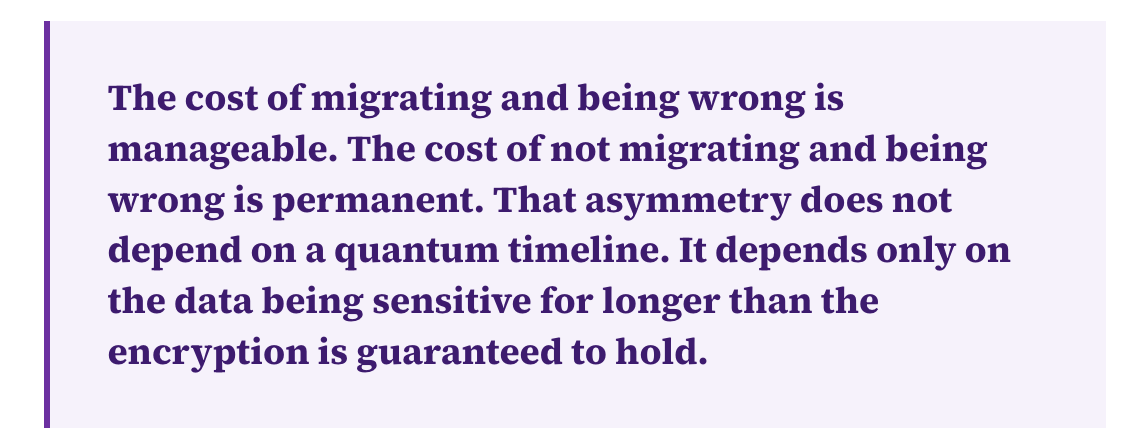
The report frames the decision through what it calls the asymmetry of regret. Migrate and turn out to be wrong about the quantum timeline, and the cost is stronger cryptography deployed earlier than strictly needed. Do not migrate and turn out to be wrong, and lifetime-sensitive data is permanently compromised with no remediation possible.
The recommended first action is not a migration. It is a cryptographic inventory: a complete map of where the sensitive data lives, how it is encrypted at rest and in transit, and which algorithms are in use. That map is the prerequisite for everything downstream, and it can begin immediately. You cannot migrate, prioritize, or even price the risk until you know what you have.
Read the full report
Find. Prove. Fix.
Sources
1. 2026 FIFA World Cup, opening match Mexico vs South Africa, Estadio Azteca, Mexico City, June 11, 2026. 104 matches, 16 host cities across the United States, Canada, and Mexico, June 11 to July 19, 2026. fifa.com tournament records.
2. FIFA Pre-Competition Medical Assessment program, compulsory for all FIFA competitions since 2010. Junge et al., British Journal of Sports Medicine, 2012. FIFA cardiac screening consensus statement, BJSM, 2025, drawing on the 2024 global screening survey.
3. FIFA Connect global registration system, integration mandated by FIFA Circulars 1654 (2018) and 1679 (2019). inside.fifa.com.
4. Public roles of George Weah (President of Liberia, 2018 to 2024) and other footballers who entered national office, drawn from public records. Named individuals appear solely as documented examples of a general pattern.
5. Bulk signals-intelligence collection from fiber-optic infrastructure, per the 2013 Snowden disclosures (reported by The Guardian and The Washington Post) and subsequent reporting. The threat model is structural, not an allegation of a specific operation against football data.
Full source documentation and evidence index in the linked report, Appendix A.
Qtonic Quantum Corp is a leading quantum risk and vulnerability intelligence firm. Its platforms and advisory services help enterprises and government agencies reach post-quantum readiness and sustain it continuously, as standards, threats, and infrastructure evolve. Qtonic Quantum is vendor-neutral by design, scoring and recommending what works rather than what a vendor sells. Headquartered in Miami, with operations in Be’er Sheva, Israel. Find. Prove. Fix.
Qtonic Quantum Corp
Miami, FL
+1 (866) 4-QTONIC
info@qtonicquantum.com · qtonicquantum.com
This article is provided for informational and educational purposes only. It is a summary of a public research report and a statement of opinion, not an allegation of fact, and it does not constitute legal, regulatory, compliance, security, investment, or other professional advice. It does not allege that FIFA, any confederation, any member association, or any individual has experienced a data breach, or that any harvest-now-decrypt-later operation is targeting football data. Individuals named appear solely as publicly documented examples of athletes who later entered public life; no statement is made or implied that any named individual’s data has been collected, intercepted, harvested, transmitted, or decrypted, or that any named individual faces any specific or actual risk. References to FIFA and all third-party names and marks are for identification and commentary only and imply no affiliation or endorsement. The March 2026 research preprints referenced reflect analysis subject to peer review and revision. Qtonic Quantum offers commercial services in the field this article addresses; readers should weigh that interest and obtain independent professional advice specific to their circumstances. Qtonic Quantum disclaims all liability for actions taken or not taken in reliance on this article. © 2026 Qtonic Quantum Corp. All rights reserved. Qtonic Quantum, QScout, QStrike, QSolve, and Qtonic Quantum Laboratory are trademarks of Qtonic Quantum Corp.