

Microsoft Moved Its Quantum Deadline to 2029. The Hard Part It Named Is the Step You Skipped.
You cannot protect the cryptography you have never found.

Qtonic Quantum Research Team | July 4, 2026

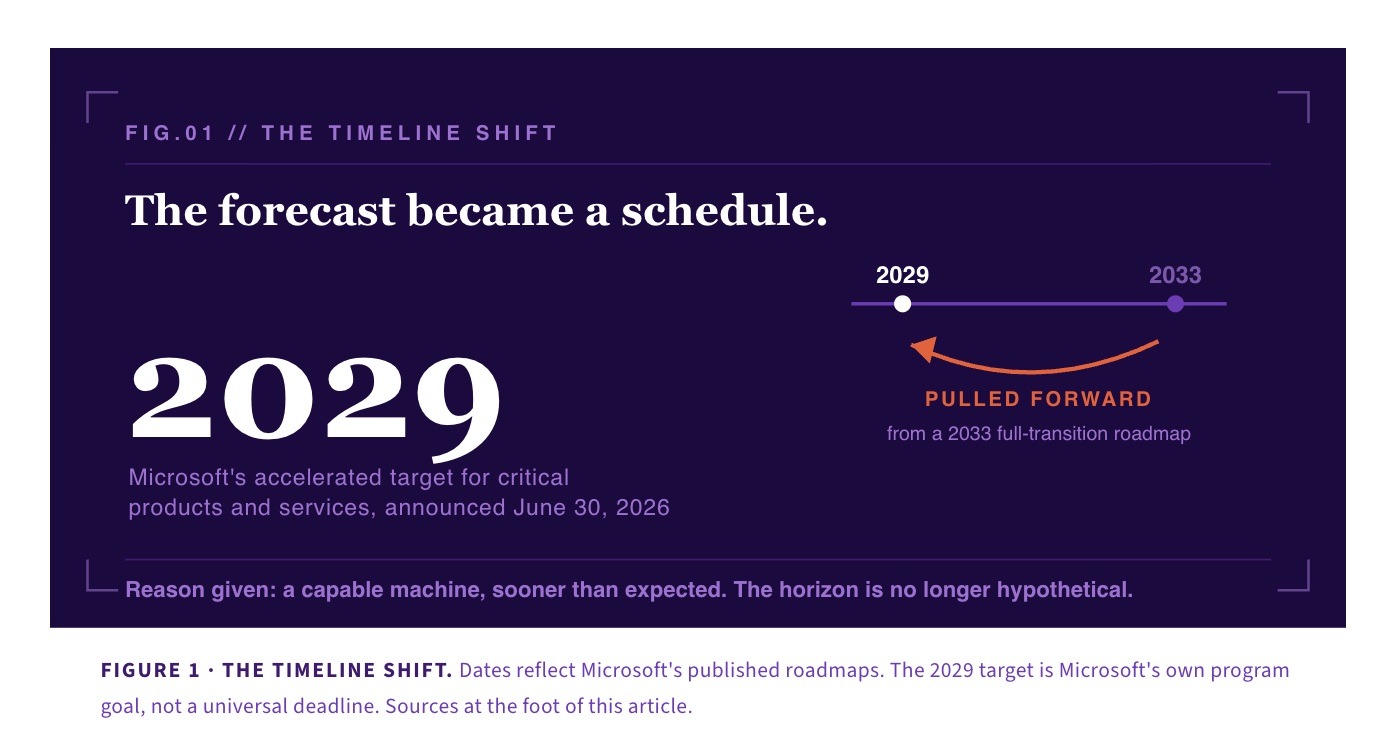
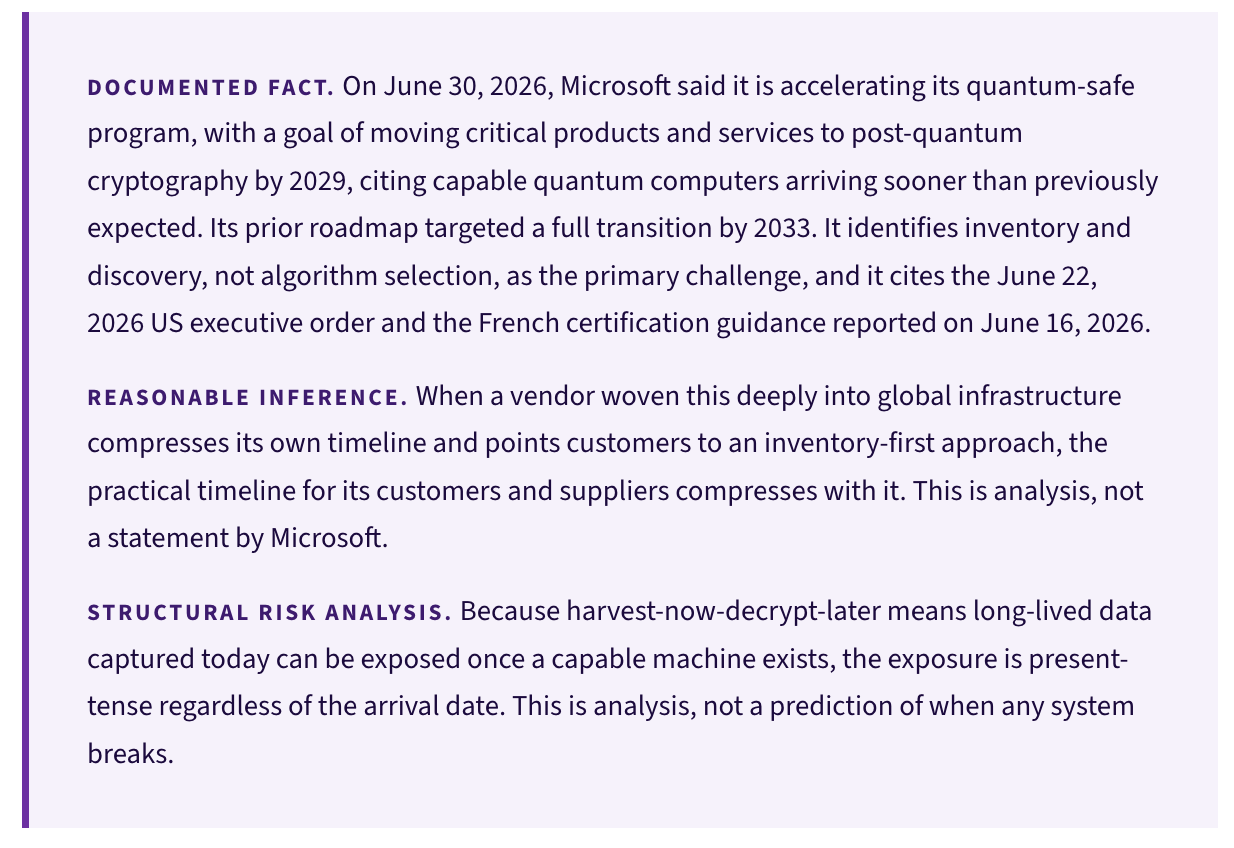
On June 30, 2026, Microsoft moved a date. The company said it would transition its critical products and services to post-quantum cryptography by 2029, well ahead of the roadmap it published a year earlier, because it now believes a capable quantum computer could arrive sooner than expected. The number matters less than the source. When the vendor that a large share of the world runs on pulls its own deadline forward, a forecast turns into a schedule.
The reason to move is not the date. Harvest-now attacks make long-lived data exposed today, a cryptographic migration runs for years, and the first task is the one almost no organization has finished. Microsoft named that task in plain terms. It is not choosing an algorithm. It is finding where your cryptography already lives.
One more thing about the date this piece goes out. July 4, 2026 marks 250 years of American independence, and the anniversary is not decoration here. The revolution ran on protected communications. Washington’s intelligence network moved its reports under cipher, code names, and invisible ink because a single intercepted letter could cost the war. Two and a half centuries later, the country’s commerce, infrastructure, and defense run on a different kind of protected communication, public-key cryptography, and for the first time the mathematics underneath it comes with a projected retirement date. Harvest-now attacks give that anniversary a sharp edge. The records worth keeping for the next chapter are being captured today, under keys the next decade is expected to retire. A 250th birthday is a reasonable moment to ask which of them you could still protect.
The announcement came from Mark Russinovich, the chief technology officer of Microsoft Azure. Notice where the pressure is now coming from. For three years the push to go quantum-safe came from governments, from NIST standards, from national security directives, and last month from an executive order. This came from the vendor your business runs on. That is a different kind of deadline. It arrives through your supply chain instead of the Federal Register.
The vendor moved its own clock
A year ago, Microsoft’s public roadmap aimed to complete its transition to post-quantum cryptography by 2033, with early adoption beginning around 2029, a schedule it described as two years ahead of the 2035 date most governments set. On June 30, 2026, that posture changed. Microsoft accelerated, setting a goal to move its critical products and services to post-quantum cryptography by 2029, and it gave a reason. It now believes machines capable of breaking today’s encryption could arrive sooner than it previously expected.
Read that as an engineering decision, not a press release. Microsoft is one of the few companies that both builds quantum computers and defends against them, and it runs on its own cryptography at a scale almost no one matches. When a program like that compresses its timeline and writes the compression into its milestones, it is telling you what its own risk models now say. The 2029 date is Microsoft’s own target, not a rule that binds you. The direction of travel is the part you cannot ignore.
When the platform moves, you move
Here is why a vendor’s internal deadline is your problem. Most organizations do not run their own cryptography from the ground up. They run on Windows, on Azure, on Microsoft 365, on the identity, certificate, and signing services underneath them, and on the same libraries that ship inside all of it. Most of the working world touches a Microsoft product every day. When Microsoft rebuilds those foundations to be quantum-safe on a compressed schedule, the timeline propagates. Your protocols shift under you, your defaults change, and the questions your customers and auditors ask start to assume you have kept pace.
There is no mandate in this, and that is what makes it land. A rule can be delayed and a regulator can be lobbied. A platform default cannot. As Microsoft modernizes its network cryptography to enable hybrid post-quantum key exchange and updates the identity, certificate, and signing services underneath its stack, your systems inherit the change on Microsoft’s schedule rather than yours, and your customers’ security questionnaires start asking whether you have kept pace. The 2029 date stops being a Microsoft date. It becomes a marker for everything downstream of Microsoft, which is much of enterprise infrastructure.
The hard part was never the algorithm
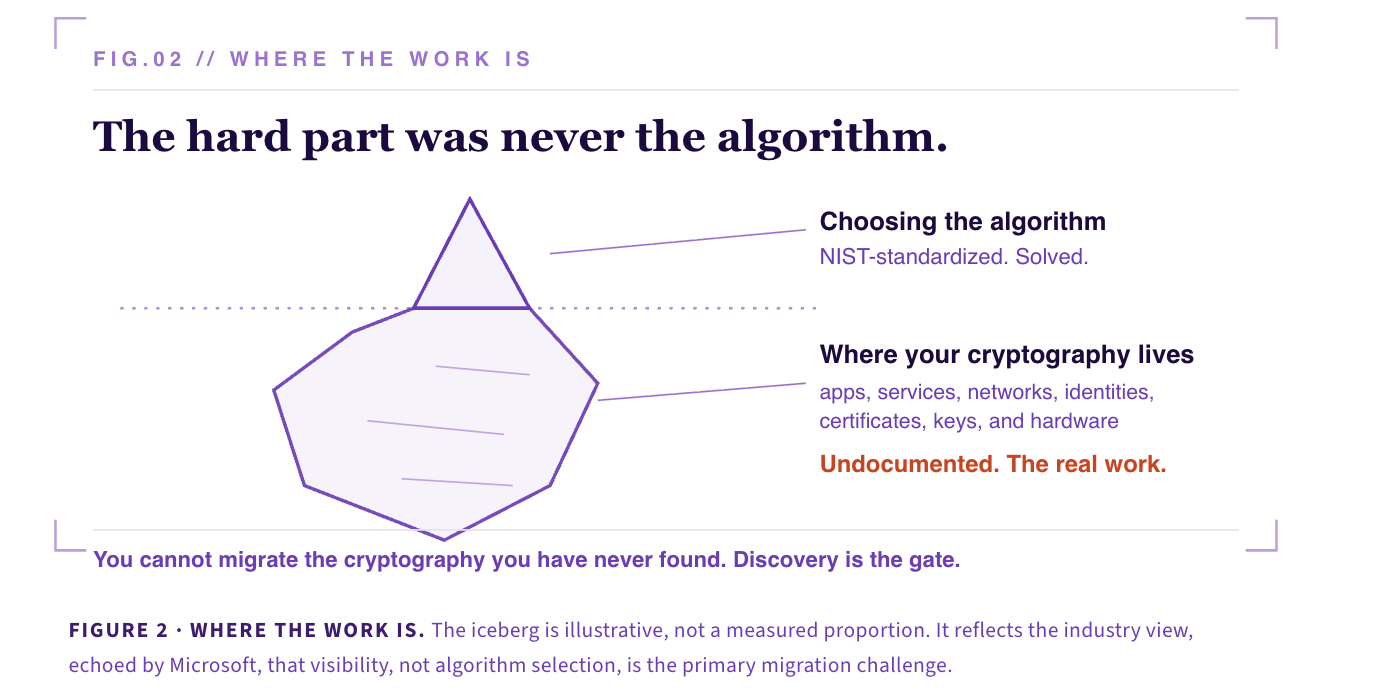
The most useful sentence in Microsoft’s post is the one about difficulty. The algorithms are settled. NIST finalized the core post-quantum standards in 2024, so the standards now have names. Microsoft’s point is that naming them was never the work. The work is understanding and updating where cryptography already exists, across applications, services, networks, identities, certificates, and hardware, most of it undocumented and some of it older than the people maintaining it. That is not a math problem. It is a visibility problem.
Microsoft knows this because it lived it. Its own transition began with an enterprise-wide inventory to find and prioritize cryptographic assets before a single algorithm was swapped. Now the company is telling customers to do the same thing, and to treat that inventory as a living record rather than a one-time audit. The reason is simple and it survives every argument about quantum timelines. You cannot migrate the cryptography you have never found, and you cannot prove you are ready if you cannot see what you depend on.
Not one company’s opinion
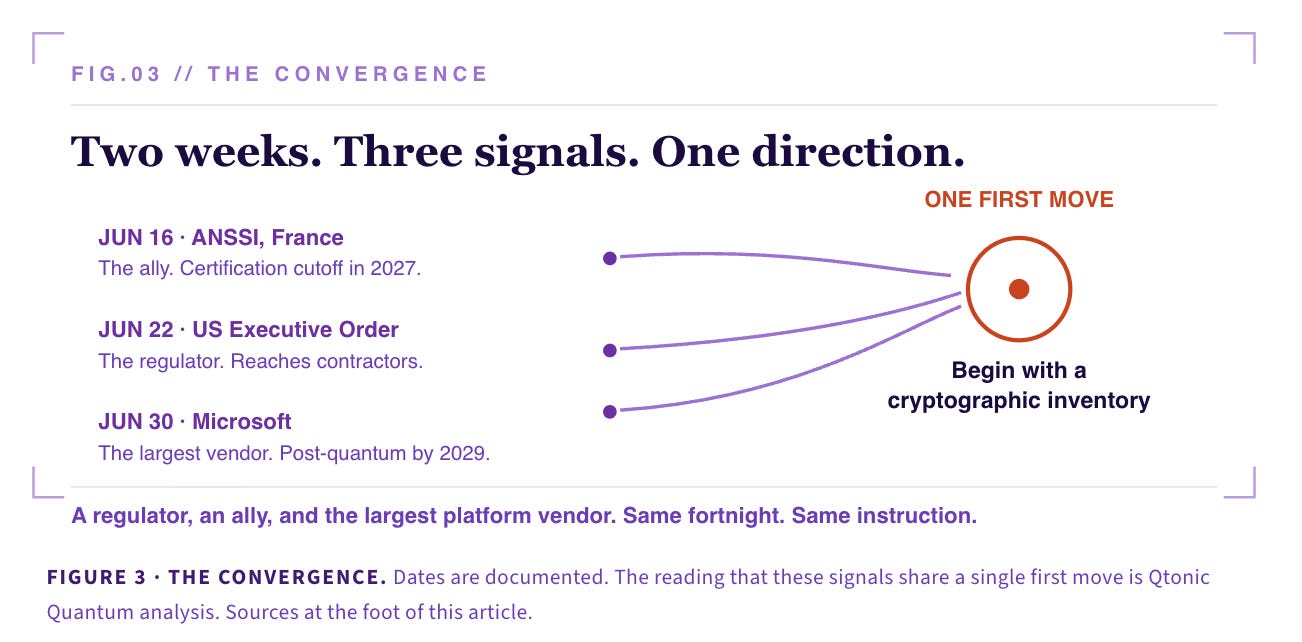
If this were only Microsoft, you could file it as one vendor’s roadmap. The record says otherwise. Inside the same two weeks, the French cybersecurity agency said it will stop certifying products that lack quantum-resistant encryption from 2027, and the United States signed an executive order accelerating federal post-quantum migration and reaching contractors through the acquisition rules. Microsoft cites both. A regulator, an ally, and the largest platform vendor pointed in the same direction inside a single fortnight, and each of them landed on the same first move.
The platforms were already moving
The fortnight also had a run-up, and it came from some of the largest traffic carriers on the internet. Cloudflare has been deploying post-quantum key agreement across its network since 2023, has reported through its state-of-the-post-quantum-internet series that a substantial and growing share of the human web traffic it carries is already protected by hybrid post-quantum key exchange, and has set its own goal of full post-quantum protection by 2029. Read that year again. The edge network and the platform vendor arrived at the same date independently.
Meta wrote up its own migration in a 2024 engineering post, and the detail that matters is the order of operations. It moved internal traffic to hybrid post-quantum key exchange first, before any external mandate, and it named harvest-now-decrypt-later as the reason to act while capable machines remain years away. Google pushed the same change to the browser itself, enabling hybrid post-quantum key exchange by default in Chrome in 2024 and adding quantum-safe digital signatures to its cloud key management service in 2025. Then, in May 2025, a Google Quantum AI researcher published an updated estimate cutting the projected resources needed to break RSA-2048 by roughly a factor of twenty against the 2019 baseline. The horizon keeps moving closer on paper before any machine exists in a lab, and the people moving it are the ones building the machines.
None of these companies waited for a rule, and none of them started with an algorithm. Each began by finding what it was running. The convergence Figure 3 shows inside a fortnight has been building across the platform layer for three years, and Microsoft’s June 30 move reads less like a departure than a confirmation.
What this means for a board
For a board, the framing is simple and it does not depend on which deadline binds you. The exposure is live now under harvest-now logic, a cryptographic migration is a multi-year program, so a 2029 date, or a 2027 one, is a budget line this cycle rather than a task for later. The vendor timeline and the procurement questions both arrive before any rule is final. Whether your pressure comes from Microsoft, from a regulator, or from a customer questionnaire, the first move is the same: a map of the cryptography you are actually running.
What Qtonic Quantum brings to the fight
Qtonic Quantum is a quantum risk and vulnerability intelligence firm, vendor-neutral by design. Microsoft just named the gating move, a cryptographic inventory, and that is where Qtonic Quantum starts. QScout finds the exposure, mapping where systems still depend on RSA and elliptic-curve cryptography across key establishment, signatures, certificates, and authentication, including the external surface an adversary or an auditor sees first. QStrike helps demonstrate what that exposure could mean under forward-threat assumptions, in terms a board will act on. QSolve turns the findings into a migration plan you can fund and sequence. Within the authorized scope of an engagement, the deliverables are concrete: a cryptographic inventory and cryptographic bill of materials, a harvest-now exposure map, an algorithm dependency register, a certificate and key risk view, and a sequenced migration plan with named owners. Because the firm sells no cryptography of its own, the inventory stays honest. Microsoft began its own transition with an inventory, and so does everyone who is serious. The output is not a warning but a program, with dates, owners, and a line in the budget.
Plenty of firms will now offer to sell a quantum story, so the case for this one rests on claims you can check. Qtonic Quantum sells no cryptography, no hardware, and no migration stack of its own, which means the inventory has no thumb on the scale, and Qtonic Quantum Lab scores implementations independently, so what gets deployed is verified rather than assumed. The field corpus behind QScout, more than 162,000 findings across more than 50 Fortune 1000 engagements, is one of the largest independent evidence bases on enterprise cryptographic exposure anywhere, which means an assessment starts from what estates actually look like instead of from a checklist. And because QScout maps findings against 15 compliance frameworks and treats the inventory as a living record, the posture Microsoft now recommends, readiness holds as standards move rather than expiring with the report.
The evidence base behind that first move is not theoretical.
QScout Field Signal
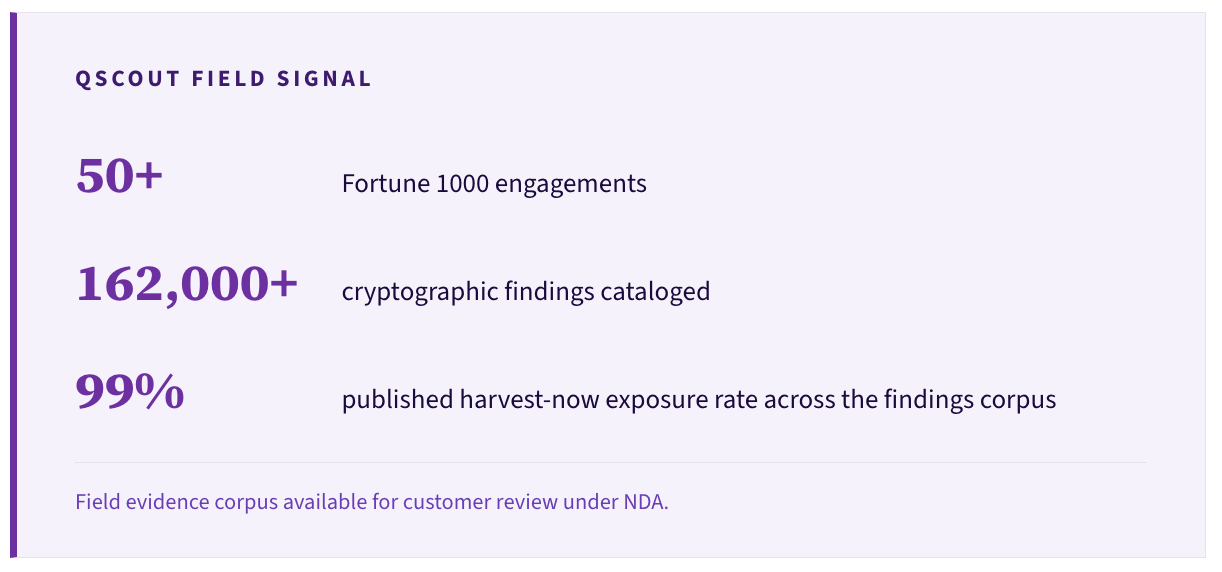
The exposure Microsoft is warning about is not the exception in enterprise environments but the default state of any estate that has never run the inventory.

Start a scoped discovery assessment
Devil’s Advocate
Microsoft builds quantum computers as well as defenses. Its own hardware work gives it a reason to frame the horizon as near, and a security roadmap to sell alongside the warning, so a skeptic can fairly say the 2029 date is as much narrative as it is engineering. Grant the point. It does not change the arithmetic. Harvest-now-decrypt-later makes long-lived data exposed today whatever the arrival date, and a cryptographic inventory pays for itself by surfacing weak keys, expired certificates, and forgotten dependencies that need attention now, independent of quantum risk. The action holds even if the timeline slips. That is the test of a move worth making now.
The founding generation treated secure communication as survival infrastructure. On the republic’s 250th birthday, the modern version of that discipline starts with a smaller and plainer act. Find what you are running.
Find. Prove. Fix.
Qtonic Quantum Corp is a quantum risk and vulnerability intelligence firm. Its platforms and advisory services help enterprises and government agencies reach post-quantum readiness and sustain it continuously, as standards, threats, and infrastructure evolve. Qtonic Quantum is vendor-neutral by design, scoring and recommending what works rather than what a vendor sells. Headquartered in Miami, with operations in Be’er Sheva, Israel. Find. Prove. Fix.
Qtonic Quantum Corp
Miami, FL
+1 (866) 4-QTONIC
info@qtonicquantum.com · qtonicquantum.com
This article is provided for informational and educational purposes only. It is a commentary on published vendor and government materials and public reporting and a statement of opinion, not a prediction of fact, and it does not constitute legal, regulatory, compliance, security, investment, or other professional advice. The 2029 date is Microsoft’s own program goal and not a universal deadline. Forward-looking timelines and quantum-arrival estimates are engineering estimates, not commitments or predictions. Third-party names and marks, including Microsoft, Azure, Windows, Meta, Cloudflare, Google, Chrome, NIST, ANSSI, the White House, Reuters, BleepingComputer, and Infosecurity Magazine, belong to their respective owners and are used for identification and commentary only. Readers should obtain independent professional advice specific to their circumstances. © 2026 Qtonic Quantum Corp. All rights reserved. Qtonic Quantum, QScout, QStrike, QSolve, and Qtonic Quantum Lab are trademarks of Qtonic Quantum Corp.