

Washington Just Ordered a Quantum Rule for "Covered Contractors." Nobody Can Say Yet If That's You.
Executive Order 14412 uses the term twice and defines it nowhere. The proposed rule that should clarify its scope is due around December 19, 2026. Your prime may ask sooner.

Qtonic Quantum Research Team | July 9, 2026
Executive Order 14412 uses the term twice and defines it nowhere. The proposed rule that should clarify its scope is due around December 19, 2026, and prime contractors may start asking suppliers for cryptographic evidence before any rule is final. Here is what the order actually requires, and when.

Sometime in the next two quarters, a contracting officer or a prime contractor may well ask your organization a question it probably cannot answer. Not whether you are ready for 2030. Whether you can produce a current, machine-readable inventory of the cryptography running across your environment.
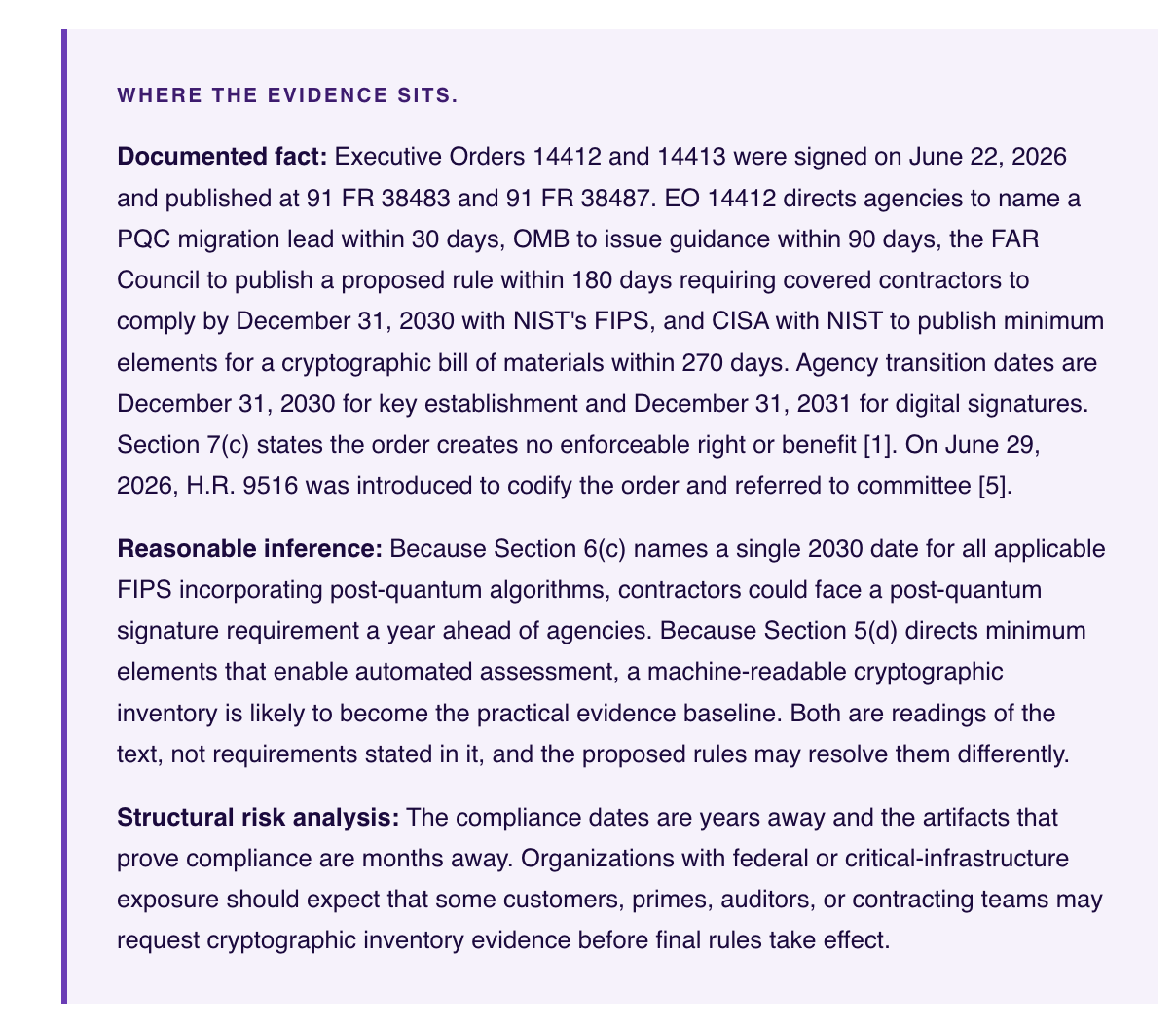
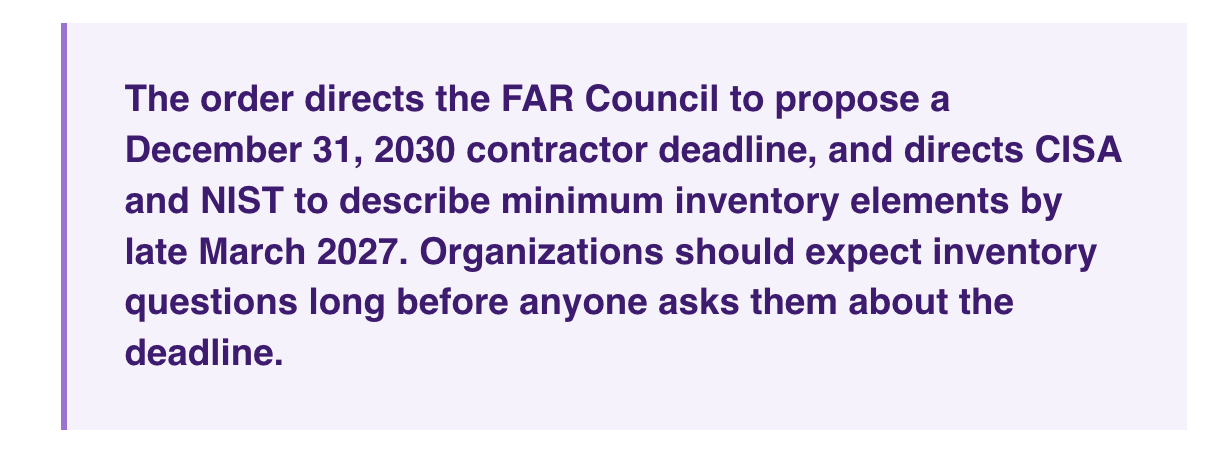
That question has a schedule now. On June 22, 2026, Executive Order 14412 directed the Federal Acquisition Regulatory Council to publish, within 180 days, a proposed rule requiring covered contractors to comply by December 31, 2030 with NIST’s Federal Information Processing Standards, including all applicable standards incorporating post-quantum algorithms [1]. Counted from the signing date, that proposal is due around December 19, 2026 [4]. Ninety days after that, CISA and NIST are directed to publish guidance on the minimum elements of a cryptographic bill of materials [1].
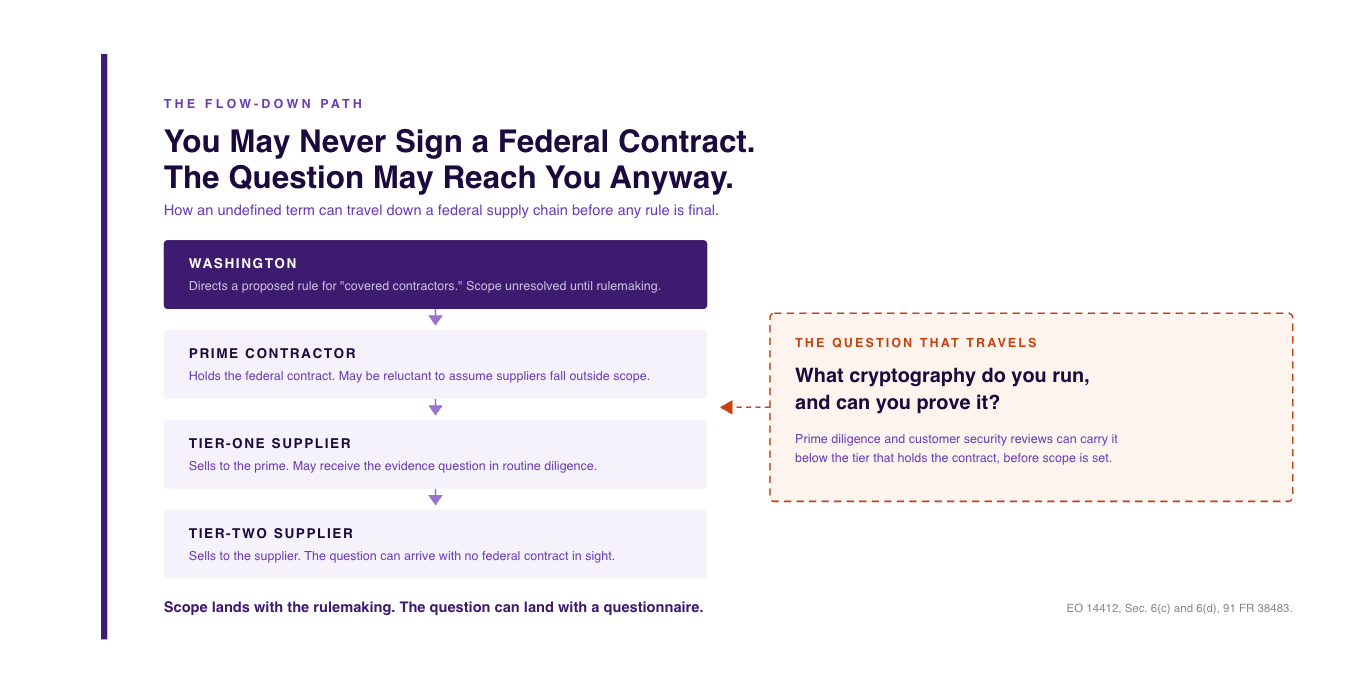
Here is the part that should change how a board hears this. The order uses the phrase “covered contractors” twice and defines it nowhere [1]. Scope will be settled in the rulemaking. The Executive Order alone does not establish which contractors, subcontractors, contract types, or systems the forthcoming rule will cover, and primes with affected federal work may be reluctant to assume relevant suppliers fall outside it.
An undefined scope is not an exemption. It can propagate questions through affected federal supply chains long before the rule resolves them. The organizations that will handle those questions calmly are the ones that already know what cryptography they run.
Three Things the Text Says That the Summaries Do Not
Most published summaries of EO 14412 restate the 2030 and 2031 dates accurately. KPMG’s July 2026 Regulatory Insights alert provides a detailed mapping of the innovation order and summarizes the contractor and critical-infrastructure implications of the protection order, advising both groups to watch for forthcoming migration guidance [3]. Watching is the right instruction. This article applies a closer contractor-focused reading to the protection order, because its operational content sits in three details a summary cannot carry, and each is checkable against the Federal Register in a few minutes.
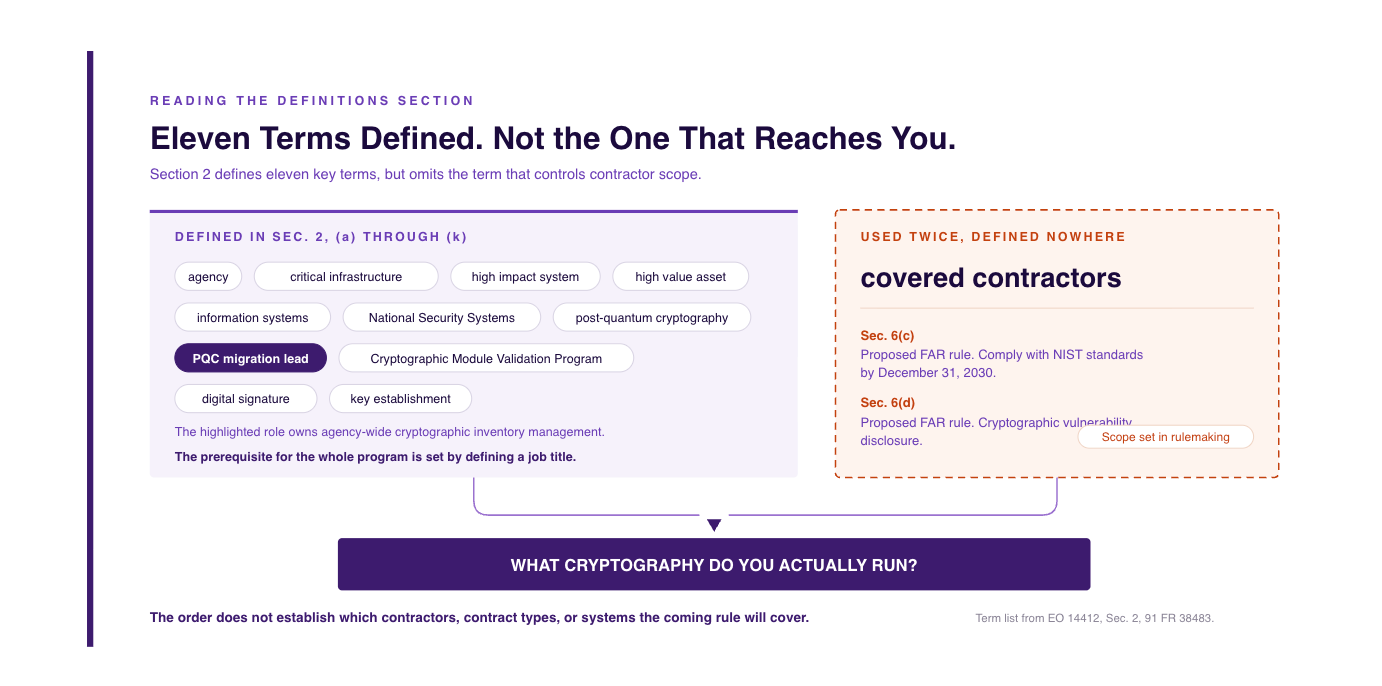
First, the order defines eleven terms and omits the one that matters to industry. Section 2 defines agency, critical infrastructure, high impact system, high value asset, information systems, National Security Systems, post-quantum cryptography, PQC migration lead, the Cryptographic Module Validation Program, digital signature, and key establishment [1]. The phrase “covered contractors” appears in Section 6(c) and again in Section 6(d), and it is defined nowhere in the order [1]. The population of companies that will be bound is left to the rulemaking. A business with no federal contracts and no supply-chain role may have solid grounds to conclude it is out of scope. For everyone else, the order settles nothing, and ambiguity of that kind does not travel down a supply chain as relief. It travels as a questionnaire.
Second, the cryptographic inventory requirement lives inside a definition. Section 4 never uses the phrase. It directs agencies to review their inventory of high value assets and high impact systems, which is an inventory of systems [1]. The cryptographic inventory appears only in Section 2(h), which defines the PQC migration lead as the employee who reports to the agency chief information officer and oversees agency-wide cryptographic inventory management [1]. The prerequisite for the entire program is established by defining a job title.
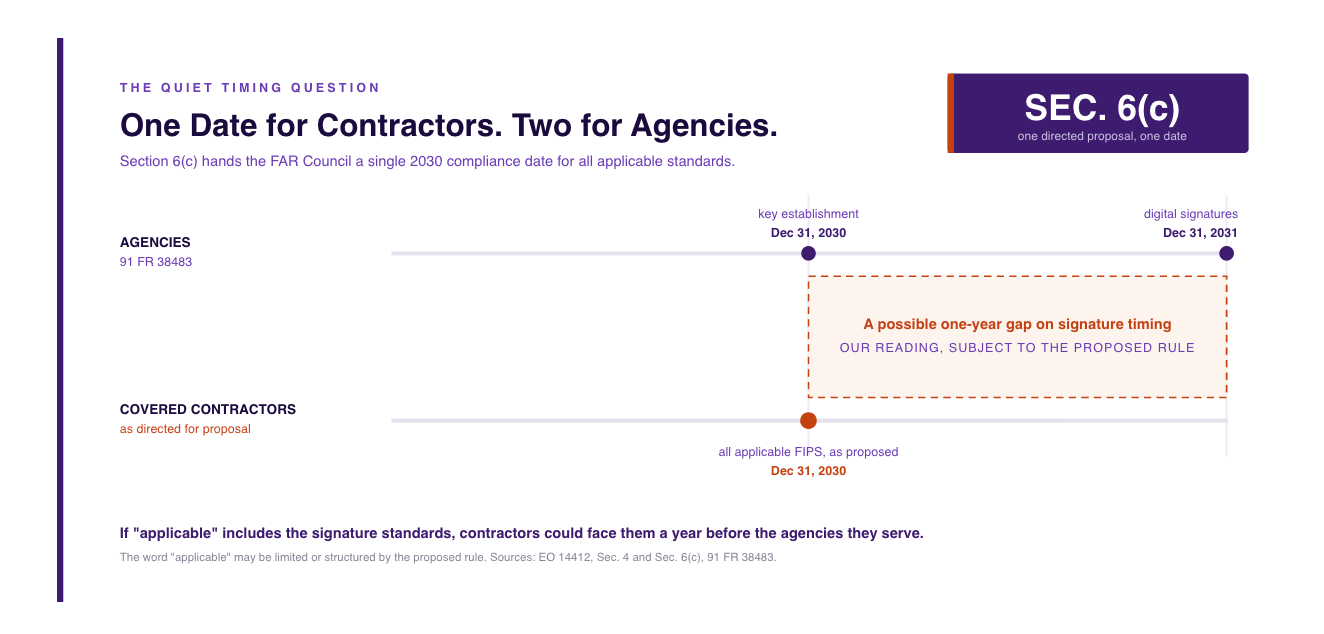
Third, contractors appear to face a tighter effective deadline than the agencies they serve. Agencies get December 31, 2030 for key establishment and December 31, 2031 for digital signatures [1]. Section 6(c) instructs the FAR Council to propose requiring covered contractors to comply by December 31, 2030 with all applicable FIPS incorporating post-quantum algorithms, a set that includes the post-quantum signature standards [1]. Under a straightforward reading of Section 6(c), contractors could face a post-quantum signature requirement a year earlier than agencies. Early summaries have tended to fold contractors into the same 2030 and 2031 split that applies to agencies, and the instruction the FAR Council actually received names one date. The word “applicable” may be limited or structured by the proposed rule, and that reading is ours rather than a stated requirement.
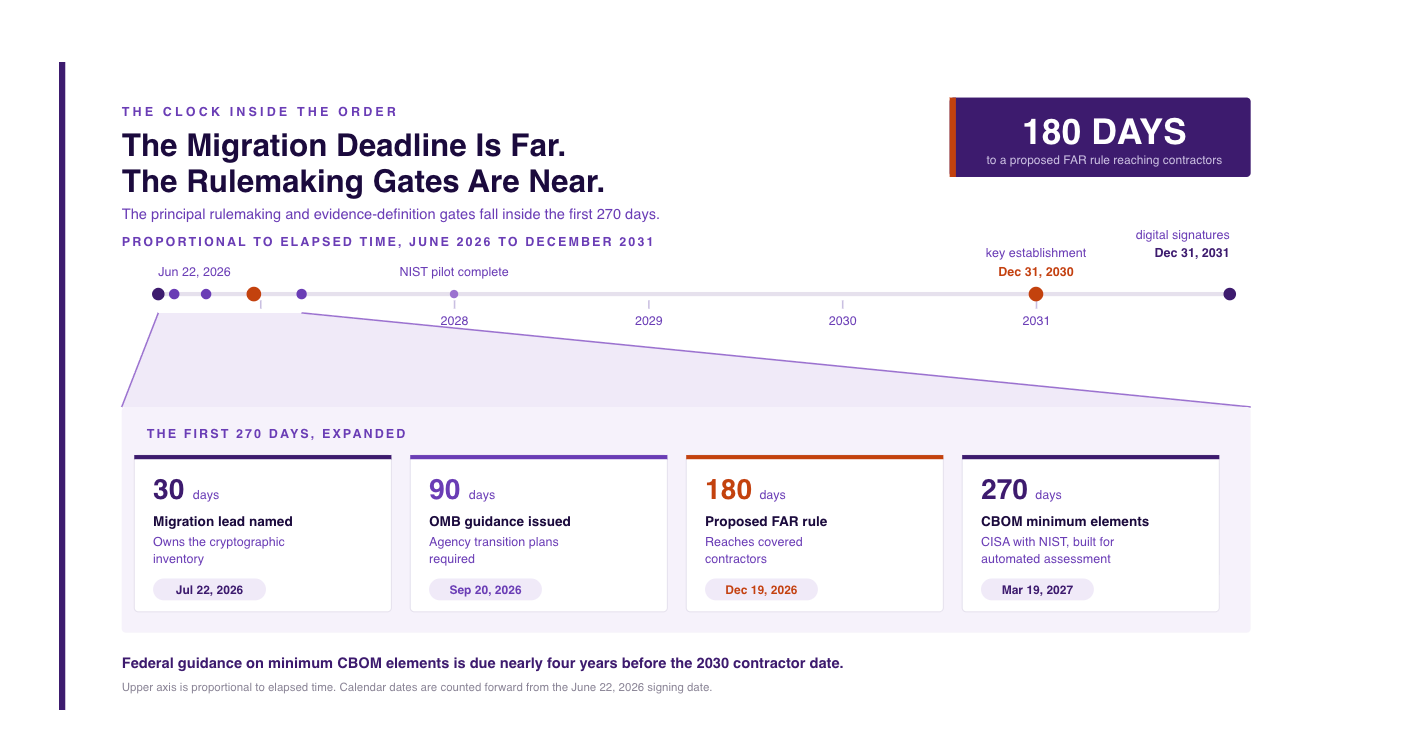
The Four Gates
Four deadlines arrive before any migration date does, and each one manufactures a question that someone will have to answer with evidence.
Thirty days. Each agency head identifies its PQC migration lead and sends the name and contact details to the Director of OMB and the National Cyber Director [1]. Counted forward, that falls around July 22, 2026 [4].
Ninety days. OMB issues guidance requiring each agency to review its inventory of high value assets and high impact systems, excluding National Security Systems, to transition those systems on the 2030 and 2031 dates, and to develop and submit a plan [1]. National Security Systems sit on a separate track, with the NSA reporting on their migration to the President through the Committee on National Security Systems [1].
One hundred eighty days. Three things land together. The FAR Council publishes the proposed contractor rule. NIST initiates a post-quantum migration pilot on a subset of its own systems, to be completed no later than December 31, 2027. And NIST revises the processes of the Cryptographic Module Validation Program to accelerate validations of cryptographic modules [1].
That last item is quieter than the others and it deserves attention. Validation is a queue, and the direction to accelerate it suggests that validation throughput may become a migration constraint, particularly for organizations waiting on newly validated post-quantum capable modules. Already-validated modules can of course be procured today. The point is that migration timing is partly a supply question and not purely an engineering one.
Two hundred seventy days. CISA, coordinating with NIST, releases public guidance describing the agencies’ considered view of the minimum elements for a cryptographic bill of materials, and the order states that those elements are to enable automated assessment of the cryptographic assets used by a hardware or software element [1]. In the same window, a second proposed FAR rule extends contractor vulnerability disclosure policies to incorporate reports of cryptographic vulnerabilities, including testing for lack of encryption and the use of non-FIPS approved algorithms [1].
Take those two together. One directs the government to describe what a cryptographic inventory needs to contain for automated assessment. The other would bring reports concerning certain cryptographic vulnerabilities, including lack of encryption and use of non-FIPS approved algorithms, within the contemplated contractor disclosure framework. The federal government is not merely setting a deadline. It is directing an assessable inventory baseline and naming the weaknesses that belong in a disclosure process.
A reader who wants to know where their own organization starts does not need to wait for any of these gates. Qtonic Quantum’s business-email-verified public intake for QScout returns a browser-safe snapshot of authorized external cryptographic exposure, with no agent and no internal network access [7].
Why This Reaches Companies That Do Not Sell to Washington
Three paths carry the order past the federal perimeter, and none of them waits for a final rule.
The first is procurement. The proposed rule publishes long before it is enforceable, and publication is likely to influence the questions primes ask their suppliers. A company that assumes it is out of scope is betting on a rulemaking nobody has read, because it does not exist yet.
The second is critical infrastructure. Sector Risk Management Agencies are directed to work with CISA to assist critical infrastructure owners and operators in developing their post-quantum migration plans [1]. That is assistance rather than obligation. Guidance of this kind often influences expectations later used by examiners, insurers, customers, and counterparties.
The third is the market moving ahead of the government. Cloudflare, which reports that more than two-thirds of the browser traffic reaching its network already uses post-quantum encryption, moved its own target for full post-quantum security to 2029, ahead of the federal dates [6]. NIST’s 2024 initial public draft transition plan proposed deprecating specified quantum-vulnerable public-key algorithms after 2030 and disallowing them after 2035 [10]. Organizations should expect some buyers to evaluate post-quantum posture without waiting for final federal rules.
None of it depends on when a cryptographically relevant quantum computer arrives. The order’s own background section frames the threat prospectively, saying large-scale quantum computers will pose a significant threat, and identifies the reason waiting is expensive anyway, which is that adversaries can collect information now and decrypt it later once such machines are operational [1]. Long-lived encrypted data captured by an adversary today may remain at risk of later decryption, which is a risk that runs on the calendar of the collection, not of the machine.
For leadership teams that want the close read without the reading, the Qtonic Quantum Research Team is holding thirty-minute briefings on what these orders say, what they do not, and what evidence a supplier should expect to be asked for. They are built for security, legal, and contracts leadership together, with no product content unless it is asked for. Request one through qtonicquantum.com.
The Measurement Layer Beneath All of It
The orders describe what must be true. They do not produce the evidence that it is true. That gap is where an independent measurement layer sits, and it follows a simple governing model. Find what you have. Prove what is at risk. Fix through evidence-led sequencing, and validate that the risk is gone.
Find. Every path above resolves to a cryptographic inventory that survives audit. QScout is built for that step, mapping cryptographic assets across the authorized scope of an engagement and producing Cryptographic Bill of Materials output, with findings mapped to 15 framework families [7]. The federal minimum elements do not exist yet. An organization that already produces a machine-readable bill of materials is positioned to map to them when guidance publishes, rather than beginning discovery in the quarter it lands. That is a judgment about sequencing, not a claim of compliance with a standard that has not been written.
Prove. Prioritization needs evidence that separates what was measured from what was assumed. QStrike evaluates defined cryptographic attack paths using provider-aligned validation workflows and, where the approved engagement design calls for it, hardware-backed demonstration against the assessed cryptographic surface [8]. It labels verified evidence separately from modeled risk, and it is bounded to a 2030 to 2031 quantum-equipped adversary model. It is not a claim that today’s hardware can break production cryptography such as RSA-2048 or ECC-256, and the order does not make that claim either.
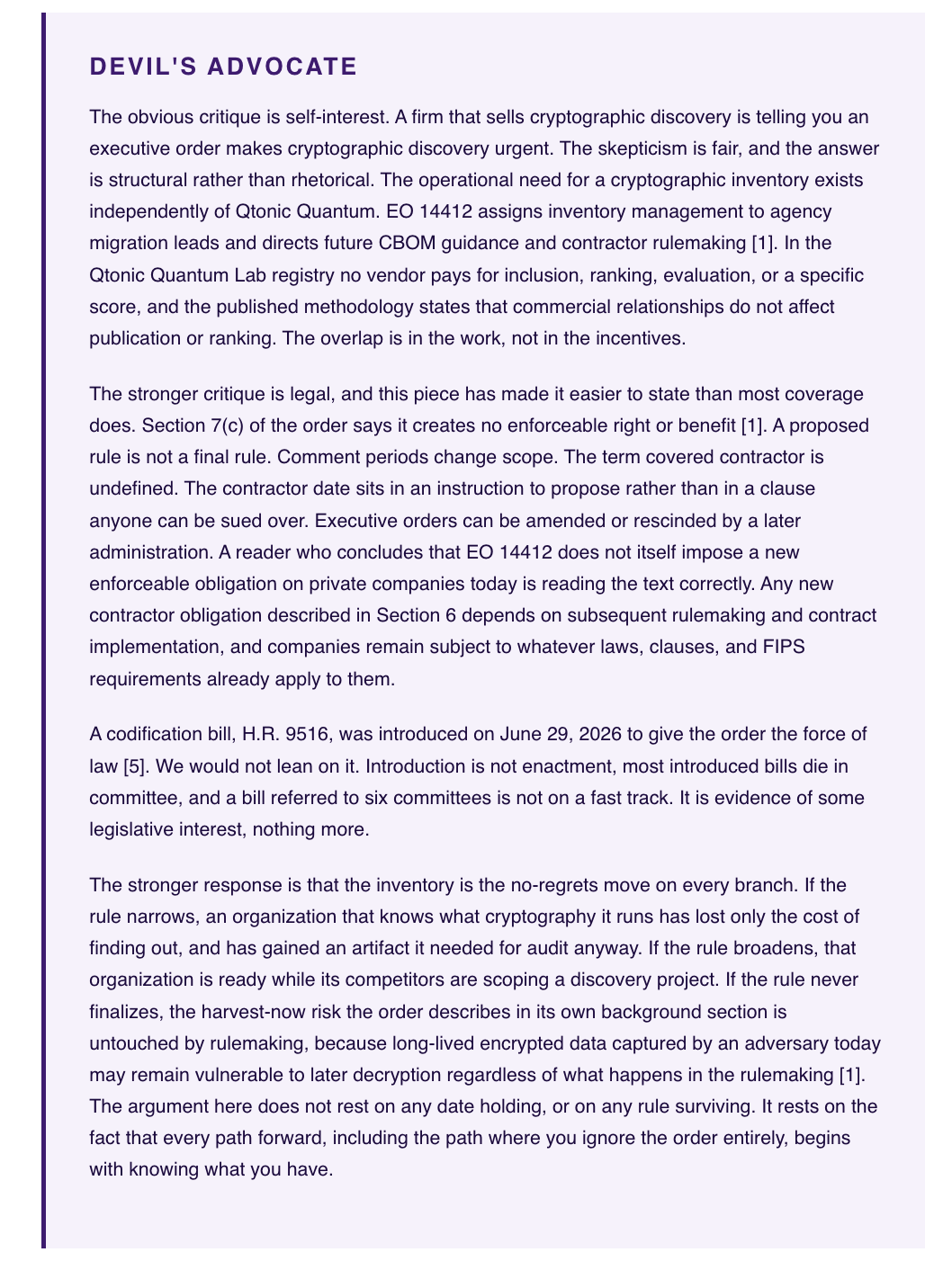
Fix. The migration plan the order asks agencies to submit has a private-sector twin, and it needs sequencing tied to the dates that actually apply. QSolve supports that plan with evidence-based migration sequencing, vendor-neutral and CISO-led [9]. It ties recommendations to Qtonic Quantum Lab records where available, and documents the evidence limitation where a scored record is not [9]. In that registry no vendor pays for inclusion, ranking, evaluation, or a specific score, and the published methodology states that commercial relationships do not affect score publication or ranking, which is what lets an advisor cite a score without inheriting a conflict [7]. When remediation is done, a QScout re-assessment tests whether previously identified exposures remain detectable within the authorized scope and documents any residual coverage gaps, and QScout Pulse keeps the inventory measured as standards and infrastructure change [7].
The companion order quietly endorses this division of labor. EO 14413 directs the Secretary of Energy to establish a national center to develop the tools and capabilities required to accurately assess the performance of quantum computing systems [2]. Building the machines and measuring what they do are treated as separate disciplines needing separate institutions. That is analysis of the orders’ structure, not a claim about any agency’s capabilities.
What to Do Before December
The reason to start is not the 2030 date. Harvest-now risk is running today. For many organizations, migration will be multi-year work that should enter current budget and architecture planning. And the procurement questions tend to arrive before the rules are final, which is the entire lesson of the 180-day gate.
The contractor-readiness and migration-planning questions examined here converge on one prerequisite, a governed cryptographic inventory. A role whose first responsibilities include establishing and governing it. A future contract clause that may be difficult to answer defensibly without one. A bill of materials that is one. So the first move is not a vendor selection, and it is not a migration strategy. It is a cryptographic bill of materials for the environment as it exists today, produced to a standard an auditor, a regulator, or a contracting officer would accept.
That is what QScout is built for. The public-intake snapshot shows the authorized, externally visible starting point. The governed assessment tiers produce the record, machine-readable CBOM, JSON, and SARIF artifacts mapped to applicable framework families, that procurement, audit, and remediation planning can rely on [7]. One is a look. The other is the evidence. Find. Prove. Fix.
The date to work backward from is not 2030. It is the first time somebody with purchasing power asks you what you are running, and you are on the clock for that already.
[1] Executive Order 14412, “Securing the Nation Against Advanced Cryptographic Attacks,” June 22, 2026, published at 91 FR 38483 (June 25, 2026). Provisions cited include Sec. 1 (background and policy), Sec. 2(a) through (k) (definitions, which do not include covered contractor), Sec. 2(h) (PQC migration lead, cryptographic inventory management), Sec. 4(a) (30-day identification), Sec. 4(b) (90-day OMB guidance, 2030 and 2031 transition dates, National Security Systems excluded), Sec. 4(c) (NIST pilot, complete no later than December 31, 2027), Sec. 5(a) (Sector Risk Management Agencies), Sec. 5(c) (NSA reporting), Sec. 5(d) (270-day cryptographic bill of materials minimum elements), Sec. 6(b) (Cryptographic Module Validation Program), Sec. 6(c) (180-day proposed FAR rule), Sec. 6(d) (270-day vulnerability disclosure rule), and Sec. 7(c) (no enforceable right or benefit). Full text at federalregister.gov
[2] Executive Order 14413, “Ushering in the Next Frontier of Quantum Innovation,” June 22, 2026, published at 91 FR 38487, establishing the Quantum Computer for Application Development and Discovery Science effort, directing a national center to assess the performance of quantum computing systems, and directing the identification of at least three next-generation quantum sensor projects within 60 days for fielding by September 30, 2028. federalregister.gov
[3] KPMG Regulatory Insights, “Executive Orders: Quantum Innovation and Protections,” Regulatory Alert, July 2026. The alert provides detailed treatment of Executive Order 14413’s workstreams and addresses Executive Order 14412 principally through summary and compliance considerations. kpmg.com
[4] The order states day counts rather than calendar dates. The dates of July 22, 2026, September 20, 2026, December 19, 2026, and March 19, 2027 are Qtonic Quantum’s arithmetic, counted forward from the June 22, 2026 signing date. Agencies may act earlier, and published guidance may arrive on other dates.
[5] H.R. 9516, 119th Congress, “To codify Executive Order 14412,” introduced by Rep. Pat Harrigan on June 29, 2026, and referred to the Committee on Oversight and Government Reform and five additional committees. Introduction is not enactment. congress.gov
[6] Cloudflare, “The White House’s post-quantum executive order is an important milestone,” 2026, reporting that Cloudflare moved its own target for full post-quantum security to 2029 and that more than two-thirds of browser traffic to its network is protected with post-quantum encryption. Accessed July 9, 2026. blog.cloudflare.com
[7] QScout’s business-email-verified public intake provides a browser-safe snapshot of authorized external cryptographic exposure, with no agent and no internal network access. Governed assessment tiers extend that signal into scoped discovery, producing Cryptographic Bill of Materials, JSON, and SARIF artifacts mapped to 15 framework families. Qtonic Quantum Lab scores post-quantum implementations against a published ten-dimension rubric using automated evaluation of publicly available evidence, posted to a public registry. No vendor pays for inclusion, ranking, evaluation, or a specific score, and the published methodology states that commercial relationships do not affect score publication or ranking. Sources: qtonicquantum.com/qscout-vs-market and qtonicquantum.com/lab/methodology, accessed July 2026.
[8] QStrike uses provider-aligned validation workflows across six commercial execution platforms and four physical modalities, superconducting, trapped-ion, neutral-atom, and annealing. It distinguishes verified evidence from modeled risk, is bounded to a 2030 to 2031 quantum-equipped adversary model, and makes no claim that today’s hardware breaks production cryptography such as RSA-2048 or ECC-256. Hardware-backed work occurs only where included in the approved engagement scope and supported by reviewable provider artifacts. Sources: qtonicquantum.com/qstrike and qtonicquantum.com/platform, accessed July 2026.
[9] QSolve is Qtonic Quantum’s vendor-neutral, CISO-led post-quantum migration governance. It sequences migration from measured exposure and validated risk, ties recommendations to Qtonic Quantum Lab records where available while separately documenting evidence limitations where a scored record is unavailable, and directs vendor execution rather than selling product. Source: qtonicquantum.com/qsolve, accessed July 9, 2026.
[10] NIST Internal Report 8547, “Transition to Post-Quantum Cryptography Standards,” Initial Public Draft, 2024. The draft proposes deprecating specified quantum-vulnerable public-key algorithms after 2030 and disallowing them after 2035. It is an initial public draft and not final binding guidance. csrc.nist.gov
Find. Prove. Fix.
Post-Quantum Ready, Continuously™
Qtonic Quantum Corp is a leading quantum risk and vulnerability intelligence firm. Its platforms and advisory services help enterprises and government agencies reach post-quantum readiness and sustain it continuously, as standards, threats, and infrastructure evolve. Qtonic Quantum is vendor-neutral by design, scoring and recommending what works rather than what a vendor sells. Headquartered in Miami, with operations in Be’er Sheva, Israel. qtonicquantum.com
QQ-BLOG-EO14412-2026-001 | PUBLISHED JULY 9, 2026 | SOURCES VERIFIED AGAINST 91 FR 38483